
Revenue Management Consultant (previously called Revenue Cloud Consultant)
Over 150 Questions | Downloadable PDF Available | Cover All 7 Sections | Updated: 2026-07-02
Read on for details about the Salesforce Certified Revenue Management Consultant exam.
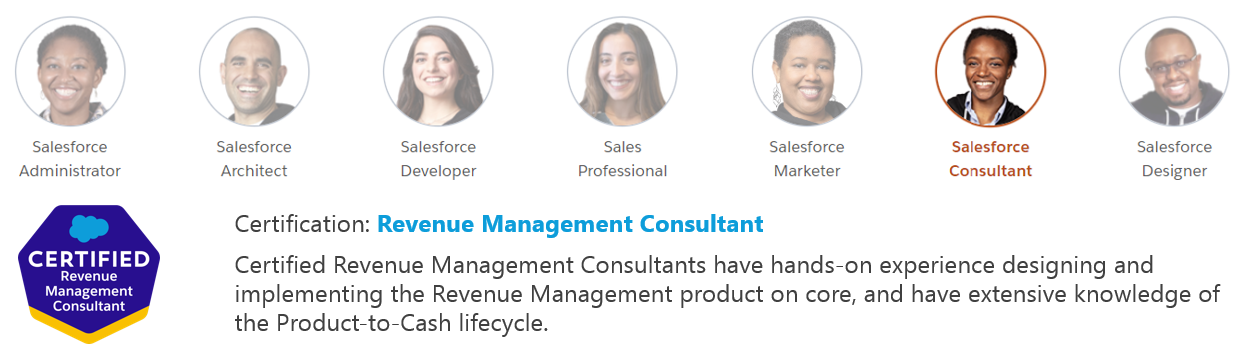
Agentforce Revenue Management Platform Concepts: 18%
Implementation Readiness: 14%
Catalog Management: 16%
Configure, Price, Quote: 18%
Contracts and Orders: 11%
Asset Management: 16%
Invoice Management: 7%
Part I: Agentforce Revenue Management Platform Concepts: 18%
Part II: Implementation Readiness: 14%
Part III: Catalog Management: 16%
Part IV: Configure, Price, Quote: 18%
Part V: Contracts and Orders: 11%
Part VI: Asset Management: 16%
Part VII: Invoice Management: 7%
Downloadable PDF Version

2026-07-06 Loved the links to resources to explain the questions. Helped me understand concepts more deeply
2026-07-06 Loved the links to resources to explain the questions. Helped me understand concepts more deeply
Read Less2026-06-30 This is the second course I’ve used PHA practice exams to study with - and have passed both. Excellent quality- and the exams are constantly being improved for better usability. Well done!
2026-06-30 This is the second course I’ve used PHA practice exams to study with - and have passed both. Excellent quality- and the exams are constantly being improved for better usability. Well done!
Read Less2026-05-20 This is a great set of questions designed to help you understand concepts and successfully answer questions. Passed the exam with this course!
2026-05-20 This is a great set of questions designed to help you understand concepts and successfully answer questions. Passed the exam with this course!
Read Less2026-05-21 I passed my certification with 90% today, Thank you so much for helping me to aprove
2026-05-21 I passed my certification with 90% today, Thank you so much for helping me to aprove
Read Less2026-04-16
2026-04-16
Read Less2026-02-01 I was struggling to pass the exam with other courses but this practice test and links to Salesforce Help documentation made it easy to learn the latest release information. I passed on my next try after going through this practice test....
Read More2026-02-01 I was struggling to pass the exam with other courses but this practice test and links to Salesforce Help documentation made it easy to learn the latest release information. I passed on my next try after going through this practice test. Thanks!
Read Less2026-03-20
2026-03-20
Read Less2026-01-15 Extremely helpful for the exam. Cannot recommend enough!
2026-01-15 Extremely helpful for the exam. Cannot recommend enough!
Read Less2025-11-20 I am glad to share that I have completed yet another Salesforce Certification! Looking forward to my 5th certification in a couple of days.
2025-11-20 I am glad to share that I have completed yet another Salesforce Certification! Looking forward to my 5th certification in a couple of days.
Read Less2026-06-10
2026-06-10
Read Less2026-06-02 Questions were Straight forward wasnt overwhelming like another brand. I definetly do see myself purchasing again! Priscilla is amazing as well answering my doubts and reassuring me as well!
2026-06-02 Questions were Straight forward wasnt overwhelming like another brand. I definetly do see myself purchasing again! Priscilla is amazing as well answering my doubts and reassuring me as well!
Read Less
Over 180 Practice Questions | Downloadable PDF Available | Cover All 5 Sections | Updated 2026-06-19
$32.99

160+Questions | Downloadable PDF available | Updated: 2026-09-05
$42.99
Upon purchase, you will receive one year of access to the practice tests for your chosen certification. The questions are organized into various sections according to the exam guidelines, allowing you to assess your knowledge. Additionally, explanations are provided after each question to enhance your understanding.
You will receive the practice tests in two formats—a downloadable PDF and an online version—so you can choose the one that best suits your study habits. Both are included at no extra cost.
Format 1: Downloadable PDF
Format 2:

Question 1:
A customer currently owns subscription products with a term of 3 years. A ramped deal was configured to sell the products with a quantity of 20 in year one, 30 in year two, and 40 in year three. The list price of the product is US $1,000 per year.
The subscription started on June 24, 2025, and will end on June 23, 2028. Today's date is January 15, 2026.
What is the formula to calculate the current Monthly Recurring Revenue (MRR)?
A. MRR = (20 × $1,000) / 12
B. MRR = (20 × $1,000) / 36
C. MRR = ((20 × $1,000) + (30 × $1,000) + (40 × $1,000)) / 36
Correct Answer: A
Explanation:
"Monthly Recurring Revenue (MRR) represents the recurring portion of subscription revenue normalized to a monthly value."
"For ramped deals, MRR should be calculated based on the currently active ramp period."
"When a subscription includes quantity changes by period, MRR is (active period's quantity× list price) ÷ 12."
Question 2:
A new order is created with these details:
*The account has a default Billing Profile with a billing address in San Francisco.
*An order is created associated with this account with a billing address in New York.
*The order has a billing account attached with a billing address in Chicago. When billing processes the order, which city will be used?
A. New York
B. Chicago
C. San Francisco
Correct Answer: B
Explanation:
*"When generating invoices, Salesforce Billing uses the billing account attached to the order as the billing entity."
*"If a billing account is specified on the order, its details (including Billing Address) take precedence over the order or account-level billing information."
*"If no billing account is provided, the system falls back to the order's billing fields, and then to the account's default billing profile." Step-by-Step Reasoning:
*Hierarchy for billing address resolution: Billing Account (highest) # Order Billing Address # Account Billing Profile (lowest).
*In this case, Billing Account (Chicago) exists and overrides all others.
*Why B is Correct: The billing process will use Chicago, because the billing account attached to the order dictates the billing details.
Question 3:
A large enterprise customer, Universal Containers (UC), has negotiated a special, long-term agreement with a software vendor for its enterprise-wide licensing. This agreement includes custom pricing tiers, specific discounts that apply only to UC across various product families, and unique billing frequencies tied to UC's fiscal year. The sales team needs to ensure that all future quotes and orders for UC automatically reflect these pre-negotiated terms. How should the sales team consistently apply these specific pricing and billing conditions for UC?
A. Use Discount Schedules on relevant products, with a Price Rule that applies these custom schedules only when UC is the designated account.
B. Establish a dedicated price book for UC that is populated with UC's negotiated prices, and includes all custom rates and specific billing rules for its products.
C. Create a Contracted Pricing record on the contract associated with the UC Account that details product- specific prices, tiered discounts, and special billing arrangements.
Correct Answer: C
Explanation: Contract Pricing in Revenue Cloud is the correct mechanism for managing long-term, negotiated customer- specific terms like those in UC's enterprise agreement. According to Salesforce Help documentation on "Contract Pricing in Revenue Cloud," Contract Pricing allows sales teams to negotiate and manage custom pricing agreements by creating Contract Item Prices and Price Adjustment Schedules tied to a specific contract.
When UC signs its enterprise agreement, a Contract record is created and associated with the UC Account.
The sales team then creates Contracted Pricing records within this contract, detailing all product-specific prices, tiered volume discounts, and special billing arrangements unique to UC. These contract-based pricing terms become "the negotiated contract prices for the customer" that Revenue Cloud applies to future transactions.
When sales reps create future quotes or orders for UC, they can initiate them from the existing active contract using the "Start a New Quote or Order From a Contract" functionality. Revenue Cloud automatically applies the contract's negotiated prices and billing frequencies to all line items. Additionally, when amending or renewing UC's assets, the system maintains these contract-based pricing terms, ensuring consistency across the entire customer lifecycle.
This approach supports UC's unique requirements: custom pricing tiers are defined in tiered volume adjustments on Contract Item Prices; specific discounts are captured in Price Adjustment Schedules; and billing frequencies tied to UC's fiscal year are configured at the contract level. All future transactions for UC automatically inherit these terms.
Option A (Discount Schedules with Price Rules) applies broadly to any account and doesn't support customer- specific governance. Option B (Dedicated Price Book) lacks the flexibility for tiered billing and special terms.
Contract Pricing is specifically designed for long-term, negotiated, customer-specific commercial agreements.
Question 4:
A Salesforce Consultant has been asked to identify and extract contract details and clauses from a PDF that holds the information of a historical signed contract. The consultant will use Contracts AI to achieve this requirement. A prerequisite to using Contracts AI is to set up a contract extraction template.
When creating a contract extraction template, which template details does the consultant need to fill in to allow the selection of an existing context definition?
A. Record Type and Field Mapping
B. Attribute Definition and Field Mapping
C. Attribute Definition and Context Mapping
Correct Answer: C
Explanation: Contracts AI in Salesforce Revenue Cloud leverages AI-based document parsing to extract key data elements (clauses, values, terms) from uploaded contract files, such as PDFs. To configure this, an administrator creates a Contract Extraction Template, which determines how AI-extracted data maps into Salesforce fields.
In order to associate the template with an existing context definition (so extracted data aligns with the correct objects and relationships), the consultant must define both:
*Attribute Definitions - specify the data elements to extract (e.g., Start Date, Term, Renewal Clause).
*Context Mapping - links the extracted attributes to the appropriate fields and nodes within the selected context definition.
Without Attribute and Context mapping, Contracts AI cannot correctly populate contextual Salesforce data structures.
Exact Extract from Salesforce Contracts AI Implementation Guide: "To use an existing context definition with a contract extraction template, specify attribute definitions and context mappings that associate extracted data with the context nodes."
Question 5:
A product administrator needs to use the Constraint Modeling Language (CML) construct available in Advanced Configurator to define a relationship for a House with up to five rooms. The relationship also requires that a MediaRoom in the color blue must be included when the house has more than three rooms.
Which option should the administrator use to accomplish this?
A. type House {relation rooms : Room[4,5];require(rooms.size > 3, rooms[MediaRoom]{color ="Blue"})};
B. type House {relation rooms : Room[0..5];require(rooms.size > 3, rooms[MediaRoom]{color ="Blue"})};
C. type House {relation rooms : Room[0..5];require(rooms.size > 3, House[MediaRoom=true, color="Blue"})};
Correct Answer: B
Explanation: Exact Extracts from Salesforce CPQ (Advanced Configurator and CML Guide):
*"CML allows you to define typed relationships and constraints within bundles or configurable products."
*"The relation syntax defines cardinality using [min..max] where 0..5 means minimum zero and maximum five related components."
*"The require() statement conditionally enforces the inclusion of components based on logical conditions. The syntax require(condition, target{attribute=value}) is used to mandate configuration rules." Step-by-Step Reasoning:
*Requirement Analysis:
*The "House" can have up to five rooms (0..5).
*If more than three rooms exist, include MediaRoom with color = "Blue."
*CML Construction:
*Define relation rooms : Room[0..5] to allow zero to five rooms.
*Apply require() to enforce conditional inclusion based on count logic.
*Why B is Correct:It follows correct CML syntax and semantics:
*Proper cardinality expression [0..5].
*Correct conditional requirement referencing rooms[MediaRoom]{color="Blue"}.
Question 6:
A sales rep adds a bundle product from the Browse Catalog and saves it to their quote. They are unable to configure the bundle from the Transaction Line Table or Browse Catalog.
Which permission is the sales rep missing?
A. Product Configuration Rules User
B. Advanced Configurator Designer
C. Product Configurator
Correct Answer: C
Explanation: To open and interact with the Revenue Cloud Product Configurator, a user must have the Product Configurator permission assigned.
From the RLM/CPQ Implementation Guide:
*"Assign the Product Configurator permission set to users who need access to the bundle configuration experience."
*"This permission enables the user to launch the configurator from the quote or catalog interface." Why other options are incorrect:
*Product Configuration Rules User: Allows rule execution but not configurator access.
*Advanced Configurator Designer: Intended for admins who design configurator flows, not for sales reps.
Question 7:
An order fulfillment orchestrator designer is setting the decomposition scope to Order Line Item at the product record level. The designer created the necessary decomposition rules in a Dynamic Revenue Orchestrator (DRO)-enabled sandbox. To test the changes, an order is created with line items that have the same product for which the decomposition rules exist. What will happen when the order is activated?
A. For every order line item that decomposes, one instance of the fulfillment order line item is created per order item.
B. For every order line item that decomposes, multiple instances of the fulfillment order line item are created per order item.
C. For every order line item that decomposes, a single instance of the fulfillment order line item is created combining all order items.
Correct Answer: A
Explanation:
*"Decomposition scope determines how order data is split into fulfillment records."
*"When the decomposition scope is set to Order Line Item, the system creates one fulfillment order line item per decomposed order line."
*"If multiple order lines reference the same product, each is decomposed independently according to its line-level data."
*"Combining order lines into a single fulfillment record only occurs when decomposition scope is at the Order level." Step-by-Step Reasoning:
*Configuration: Decomposition scope = Order Line Item.
*Behavior: Each order line item triggers its own decomposition and fulfillment record.
*Result: One fulfillment line per order line (independent of product similarity).
*Why A is Correct: Matches the expected behavior of the Order Line Item decomposition scope.
*Why B and C are Incorrect:
*B: Multiple fulfillment records per order item contradicts "one per line" rule.
*C: Combines all items - behavior of "Order" scope, not "Order Line Item."
Question 8:
What should business stakeholders and product owners do to ensure a successful discovery and design phase in a Revenue Cloud project?
A. Review all available APIs on the Revenue Cloud Developer Guide.
B. Review and map customer challenges to Revenue Cloud features.
C. Create a list of key challenges and success metrics for the project.
Correct Answer: C
Explanation: Revenue Cloud project methodology emphasizes that early stages (discovery and design) must:
*Identify key business challenges clearly.
*Define measurable success metrics and outcomes (for example, quote cycle time reduction, billing accuracy, etc.).
While mapping challenges to features (B) is important, it comes after stakeholders align on what problems they are solving and how success will be measured. Reviewing APIs (A) is a technical task, not the primary responsibility of business stakeholders.